Data does not live in one place. In any enterprise of meaningful size, a single business metric — say, "net revenue" — may originate in a SAS dataset, pass through a Python transformation script, land in a Snowflake table, get aggregated by a PySpark job, and ultimately surface in a Power BI dashboard. Understanding where that number comes from, what transformations shaped it, and which downstream reports depend on it is the fundamental problem of data lineage. MigryX Atlas solves this problem across every platform, every language, and every tool in the modern data stack.
This article explains what Atlas is, why universal data lineage matters, and how Atlas delivers column-level data lineage across SAS, Python, PySpark, R, Polars, SQL, and ETL tools — all from a single platform.
What Is MigryX Atlas?
MigryX Atlas is a universal data lineage and source-to-target mapping (STTM) platform. It parses code, scripts, queries, and ETL job definitions across multiple languages and platforms, then constructs a unified lineage graph that traces data from its origin to every destination. Atlas does not require agents installed on production systems, does not depend on runtime logs, and does not need access to the actual data. It works by analyzing the code itself — the SQL queries, the Python scripts, the SAS programs, the ETL job configurations — and extracting the transformation logic programmatically.
The result is a complete, column-level data lineage map that spans every platform in your organization. You can trace a single column from its source table through every transformation, join, filter, and aggregation to every report and dashboard that consumes it. This is not metadata tagging or manual documentation — it is automated, code-driven lineage extraction that stays current as your codebase evolves.

MigryX Atlas — Automated column-level data lineage across your entire data estate
Why Organizations Need Cross-Platform Lineage
Most organizations already have some form of lineage. The problem is that it exists in fragments. The database team knows the SQL dependencies. The analytics team has a spreadsheet documenting which SAS programs feed which reports. The data engineering team maintains a wiki page listing PySpark job dependencies. None of these fragments connect to each other, and all of them are perpetually out of date.
This fragmentation creates real business risk:
- Regulatory exposure. Regulations like GDPR, CCPA, BCBS 239, and SOX require organizations to demonstrate where sensitive data flows and how it is transformed. Fragmented lineage cannot provide this answer reliably.
- Change blindness. When a source table schema changes, teams have no reliable way to identify every downstream process that will break. The result is production failures discovered by end users, not engineers.
- Migration paralysis. Organizations planning to decommission legacy platforms (SAS, Informatica, DataStage) cannot confidently identify what depends on what. Migration projects stall because no one can quantify the blast radius of removing a single table or program.
- Duplicated effort. Without lineage, multiple teams independently build transformations for the same data, creating inconsistent definitions of the same business metric across different reports.
A data lineage tool that only covers one platform — only SQL, or only Python — cannot solve these problems. The lineage must be universal.
MigryX Atlas: Lineage That Goes Deeper
While most lineage tools stop at table-level tracking, MigryX Atlas traces every column through every transformation — joins, filters, aggregations, CASE statements, and derived calculations. It automatically generates Source-to-Target Mapping documents (STTMs) that auditors and business analysts can review without reading code. This is not just metadata scanning — it is deep semantic analysis powered by MigryX’s precision AST parsers.
How Atlas Spans Every Platform
Atlas includes dedicated parsers for each language and platform it supports. These are not regex-based pattern matchers — they are full abstract syntax tree (AST) parsers that understand the semantics of each language.
SAS
Atlas parses DATA steps, PROC SQL, PROC SORT, macro invocations, and libname references. It resolves macro variables, follows %include chains, and traces column-level transformations through merges, set operations, and conditional logic. SAS programs that have evolved over decades with deeply nested macros are fully supported.
Python and Polars
Atlas parses Python scripts that use pandas, Polars, and native Python data manipulation. It traces DataFrame operations — merges, joins, column assignments, groupby aggregations, and function calls — extracting column-level lineage from method chains and variable assignments. Polars LazyFrame chains and expression-based transformations are fully supported.
PySpark
Atlas understands Spark DataFrame operations, Spark SQL queries embedded in Python, and RDD transformations. It traces data through spark.read, .join(), .withColumn(), .groupBy().agg(), and .write operations, mapping column-level lineage across the entire Spark pipeline.
SQL and Stored Procedures
Atlas parses SQL dialects for Snowflake, PostgreSQL, Oracle, SQL Server, Teradata, and Redshift. It handles CTEs, subqueries, window functions, stored procedures, and dynamic SQL. View dependencies, materialized view refresh chains, and cross-database references are all mapped.
ETL Tools
Atlas ingests job definitions from Informatica PowerCenter, IBM DataStage, Talend, and SSIS. It parses the XML/JSON job configurations and extracts source-to-target mappings, transformation logic, and routing rules — connecting ETL-managed data flows to the broader lineage graph.
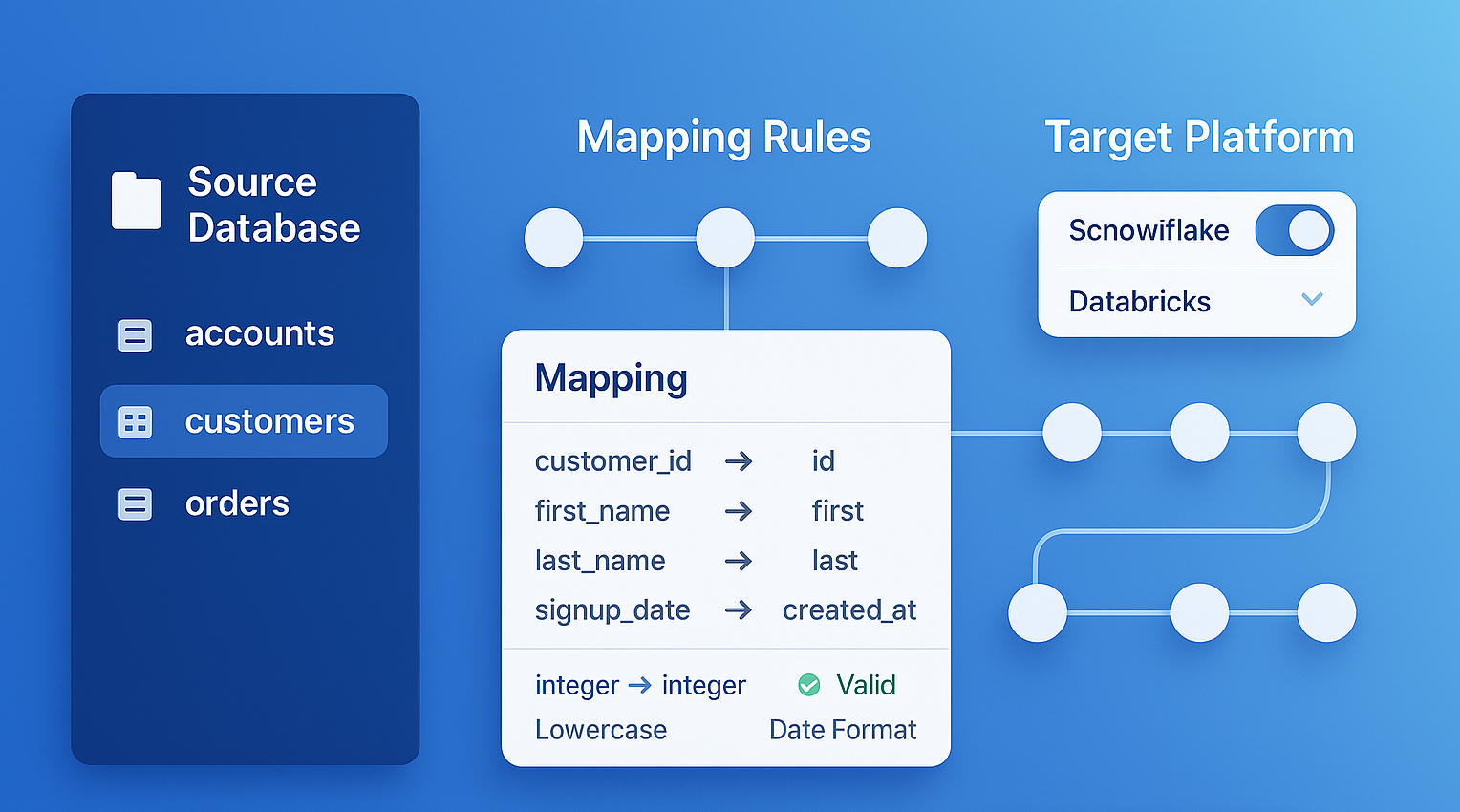
MigryX generates comprehensive Source-to-Target Mappings (STTMs) automatically, eliminating weeks of manual documentation
Why Manual Lineage Documentation Fails — And How MigryX Fixes It
Enterprise data estates contain thousands of interdependent programs. Manual lineage documentation is outdated the moment it is written. MigryX Atlas continuously analyzes your codebase and produces lineage maps that reflect the actual state of your data pipelines — not what someone documented six months ago. Teams using MigryX Atlas report reducing impact analysis time from weeks to hours.
Column-Level Lineage: The Critical Differentiator
Table-level lineage tells you that "Table A feeds Table B." This is useful but insufficient. Column-level data lineage tells you that Table_B.net_revenue is derived from Table_A.gross_sales minus Table_A.returns minus Table_A.discounts, filtered by Table_A.region = 'US', and aggregated by quarter. This level of detail is what compliance auditors require, what impact analysis depends on, and what makes lineage actionable rather than decorative.
Atlas provides column-level lineage by default. Every column in every target table or output file is traced back to the specific source columns and transformation expressions that produce it. The lineage graph captures not just the "what" but the "how" — the actual transformation logic applied at each step.
Column-level lineage is not a nice-to-have feature. It is the minimum viable lineage for any organization subject to regulatory oversight or planning a platform migration.
| Lineage Level | What It Tells You | Use Case |
|---|---|---|
| Table-level | Table A feeds Table B | Basic dependency mapping |
| Column-level | Column X derives from Columns Y and Z via specific transformations | Impact analysis, compliance, migration |
| Row-level | Specific record flows through specific path | Data quality debugging (runtime only) |
Atlas operates at the column level across all supported platforms, providing the granularity needed for serious data governance without requiring runtime instrumentation.
Real-World Impact: What Universal Lineage Enables
With Atlas deployed, organizations gain capabilities that were previously impossible or required months of manual effort.
Impact analysis in seconds. When a source column is renamed, deprecated, or its logic changes, Atlas instantly shows every downstream transformation, table, and report that depends on it. What previously required a week of manual code review becomes a single query against the lineage graph.
Migration confidence. Organizations decommissioning SAS or Informatica can use Atlas to identify every data flow that touches the legacy platform, map equivalent flows on the target platform, and verify that the migration is complete. No hidden dependencies. No surprises in production.
Regulatory compliance. Auditors asking "show me where customer PII flows in your organization" get a definitive answer — not a best-guess spreadsheet updated six months ago, but a current, code-derived lineage map that traces every PII column from source to consumption.
Data catalog enrichment. Atlas lineage feeds directly into data catalogs like Collibra, Alation, and Atlan, enriching catalog entries with automated, column-level lineage that stays synchronized with the actual codebase.
Key Takeaways
- Atlas provides universal data lineage across SAS, Python, PySpark, R, Polars, SQL, and major ETL tools from a single platform.
- Column-level data lineage is extracted automatically by parsing code — no runtime agents, no manual documentation.
- Cross-platform lineage eliminates the fragmented, stale spreadsheets that most organizations rely on today.
- Impact analysis, migration planning, and regulatory compliance all become tractable problems when lineage is complete and current.
- Atlas integrates with existing data catalogs, governance tools, and CI/CD pipelines.
Data lineage is not a new concept, but universal data lineage — lineage that spans every platform, every language, and every tool in the enterprise — has been practically unattainable until now. MigryX Atlas makes it real. By parsing the code itself rather than relying on metadata tags or runtime logs, Atlas delivers the complete, column-level lineage that modern data governance demands.
Why MigryX Is Essential for Data Lineage
The challenges described throughout this article are exactly what MigryX was built to solve. Here is how MigryX transforms this process:
- Column-level precision: MigryX traces data from source field to target column through every transformation step, not just table-to-table connections.
- Automated STTM generation: Source-to-Target Mapping documents are produced automatically, saving weeks of manual effort per migration wave.
- Cross-platform support: MigryX Atlas handles lineage across SAS, Informatica, DataStage, Alteryx, SSIS, and 20+ other technologies in a single unified view.
- Regulatory compliance: SOC 2 compliant audit trails ensure every data flow is documented for regulatory review.
MigryX combines precision AST parsing with Merlin AI to deliver 99% accurate, production-ready migration — turning what used to be a multi-year manual effort into a streamlined, validated process. See it in action.
See Atlas Universal Lineage in Action
Discover how Atlas maps column-level data lineage across your entire data ecosystem.
Explore Atlas Schedule a Demo